24h カスタマーホットライン +86 15395181370



What Are the Different Types of Deburring Machines Available?
A Practical Guide to Manual, Brush, Robotic, and Belt Deburring
The four most widely used バリ取り機 categories in metal fabrication are manual (hand) deburring, brush deburring, robotic deburring, and abrasive belt/sand belt deburring. Each removes burrs through a fundamentally different mechanism, and each fits a different combination of part geometry, production volume, and quality tolerance. Below is a direct comparison with operating steps for each.
Quick answer: Manual deburring uses handheld tools with operator judgment. Brush deburring spins abrasive-impregnated bristles against edges. Robotic deburring mounts deburring tools on articulated arms with force control. Belt deburring drives an abrasive loop across flat or contoured surfaces. The right choice depends on burr size, part accessibility, throughput requirement, and whether you need edge rounding or pure burr removal.
手動バリ取り
Mechanism: Operator-guided handheld tool removes burrs through controlled scraping, cutting, or abrasion.
Step-by-step operation:
- Inspect the workpiece and identify burr locations, material, and edge geometry.
- Select the appropriate tool — rotary burr, deburring blade, scraper, file, countersink, or abrasive-filled rubber point.
- Secure the workpiece to prevent movement during the stroke.
- Set the tool blade flat against the edge and pull with steady pressure — do not push.
- For holes, use a burr ball or countersink; follow with a reamer or toothpick for internal burrs, checking diameter tolerance at every pass.
- Clean the part and inspect under magnification for residual burrs.
- Verify critical dimensions with a “go” gauge if permitted.
Best for: Prototypes, repair work, irregular one-off parts, and situations where equipment cost must stay minimal.
Watch out for: Results vary by operator and shift; not suitable for high-volume production with tight repeatability requirements.
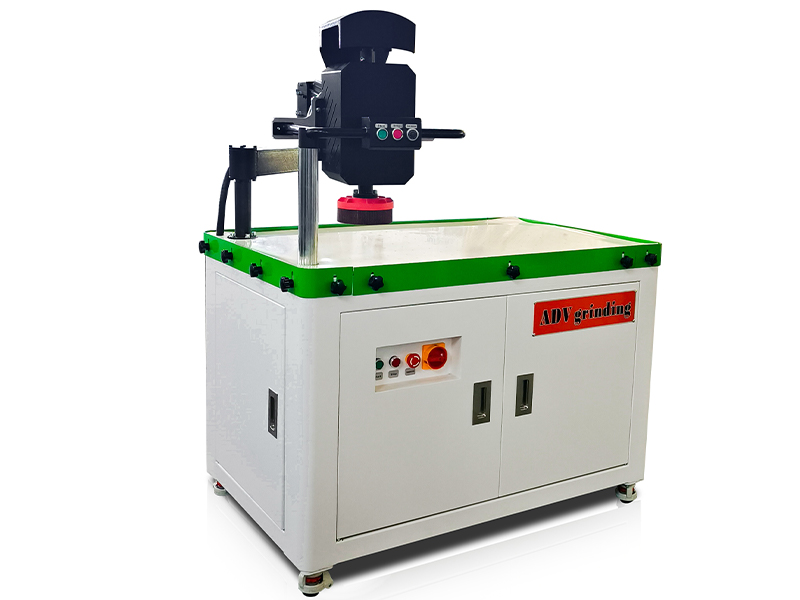
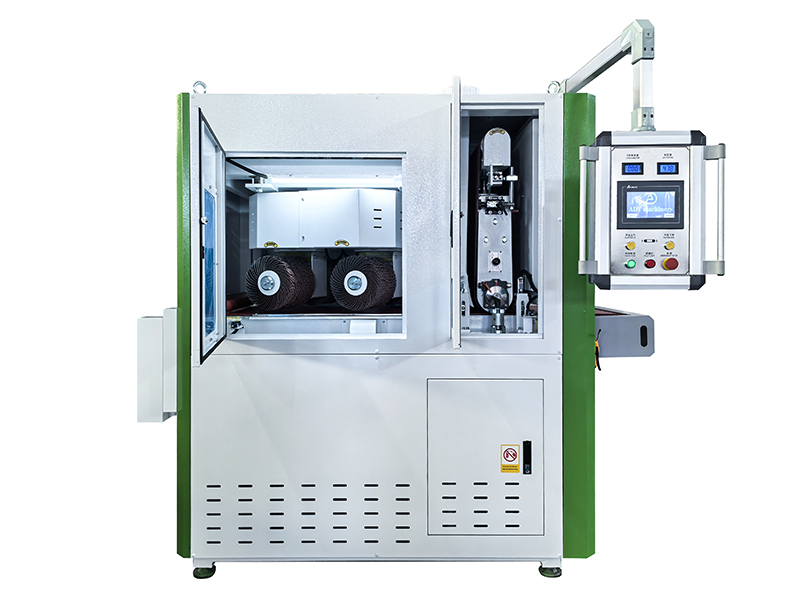
Brush Deburring
Mechanism: Rotating abrasive-impregnated bristles (nylon, wire, or composite) contact the edge, shearing burrs and blending surfaces.
Step-by-step operation:
- Mount the brush on the machine spindle — wheel, cup, roll, or disc configuration depending on part geometry.
- Set spindle speed according to brush type and material; higher speeds increase cutting aggression but accelerate wear.
- Position the workpiece so the brush contacts the burr at a consistent angle and pressure.
- Feed the part across the brush path — either the part moves or the brush traverses, depending on machine design.
- Monitor brush wear; replace or dress the brush when edge rounding becomes inconsistent.
- Inspect for uniform edge radius and absence of secondary burrs.
Best for: Edge rounding, surface blending, and contour treatment on repeatable part families. Works well on machined edges, slots, and moderate burrs.
Watch out for: Brush wear directly affects results; less effective on heavy slag or large stock removal compared to belt systems.
Robotic Deburring
Mechanism: A multi-axis robot arm carries a deburring tool (abrasive disc, brush, burr, or belt head) along a programmed path with force sensing or compliance control.
Step-by-step implementation:
- Define the burr type, material, and production problem — quality drift, labor cost, or throughput bottleneck.
- Select a passive or active deburring tool based on burr size and surface finish requirement.
- Choose a robot arm matching payload, reach, and axis needs for your largest part envelope.
- Integrate force sensing or compliance to maintain consistent pressure and prevent part damage.
- Design the cell layout with part access, tool changers, and debris management.
- Program the deburring path via manual teaching, CAD/CAM, or offline simulation.
- Run test batches, inspect edge quality, and fine-tune path speed and force.
- Train operators to load parts, monitor quality, and perform routine maintenance.
- Measure ROI against labor savings, scrap reduction, and throughput gains.
Best for: Repeatable part families where consistency, ergonomics, and round-the-clock throughput justify capital investment. Typical payback runs 12–18 months in production environments.
Watch out for: Requires stable part presentation; high variation in incoming burr location or part geometry erodes the economic case.
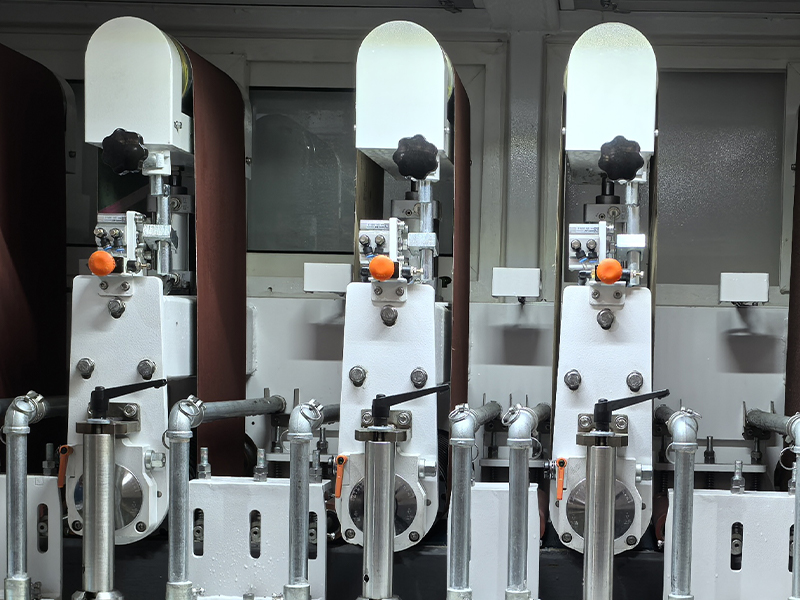
Abrasive Belt / Sand Belt Deburring
Mechanism: An abrasive belt is driven over contact wheels or platens; the workpiece is presented against the moving belt to grind burrs and condition surfaces.
Step-by-step operation:
- Open the deburring station cover and inspect the abrasive belt for damage or loading.
- Turn the machine ON and wait for the belt to reach full operating speed before contact.
- Position the workpiece at a slight angle against the belt, resting on the work rest.
- Feed the part across the belt with controlled, even pressure; avoid forcing thin sections that may over-grind.
- For through-feed machines, set conveyor height using the height probe and confirm part thickness.
- When finished, turn the machine OFF, wait for full belt stop, and close the station cover.
Best for: Sheet metal, flat parts, slag removal, heavy burr removal, and measurable surface stock removal.
Watch out for: Can over-grind thin or delicate areas; requires controlled part presentation to avoid gouging or dimensional drift. Wet belt systems extend abrasive life and eliminate dust collection needs but demand strict maintenance regimens.
Which Deburring Method Fits Your Operation?
| Method | Burr Removal | Edge Rounding | Internal Burrs | Throughput | 一貫性 |
|---|---|---|---|---|---|
| Manual | はい | Manual only | With special tools | Low | Operator-dependent |
| ブラシ | はい | Excellent | Limited | Medium | Good on repeatable contours |
| Robotic | はい | はい | With specialized tooling | 高い | 高い |
| ベルト | はい | Moderate | いいえ | Medium–High | High with stable setup |
Selection logic in three questions:
- Are the burrs on external flat edges or internal passages? Internal passages rule out belt deburring and most brush configurations.
- Is throughput measured in units per hour or parts per shift? Below a certain volume, robotic deburring’s setup cost outweighs manual flexibility.
- Does the downstream process require a specific edge radius? Brush and robotic systems control edge radius; belt systems remove stock but round less predictably.
For mixed operations, combination machines pairing a belt station with brush stations are common — the belt removes the heavy burr, the brushes blend the edge to final profile.