24h customer hotline +86 15395181370



Operational Challenges in Traditional Bending Workshops
A press brake is a type of brake, a machine used for bending sheet metal and metal plate.It forms predetermined bends by clamping the workpiece between a matching top tool and bottom die.
Producers of stainless-steel cabinets, server racks, and electrical enclosures typically work with identical materials. In many cases, they also run the same sheet thickness throughout production.
Even so, required bending lengths often vary from part to part. One component may need a 1500 mm bend, while the next may require only a 400 mm bend.
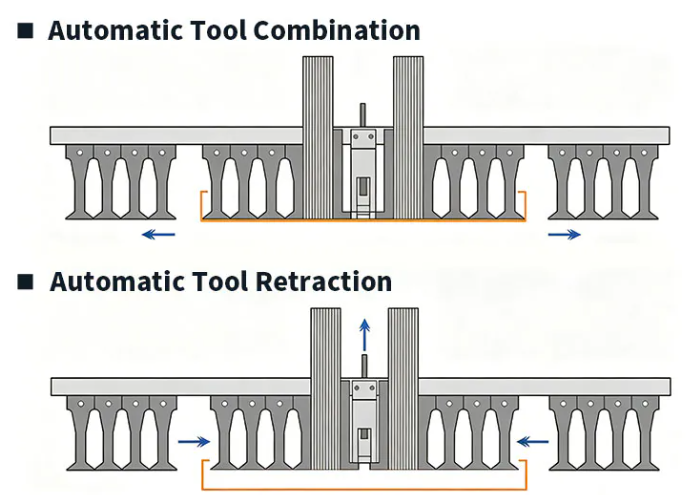
To accommodate these changing bend lengths, operators must constantly reconfigure tooling sets. They have to combine different tool lengths, carry out trial bends, and confirm bending precision before starting full production.
While these steps aren’t difficult, they take up critical shop-floor time. Repeated tool changes also lower machine uptime, reduce utilization, and ultimately restrict overall output.
What Is Automatic Machine Combination Technology?
ADV Automatic Tool Combination Technology addresses this challenge directly.
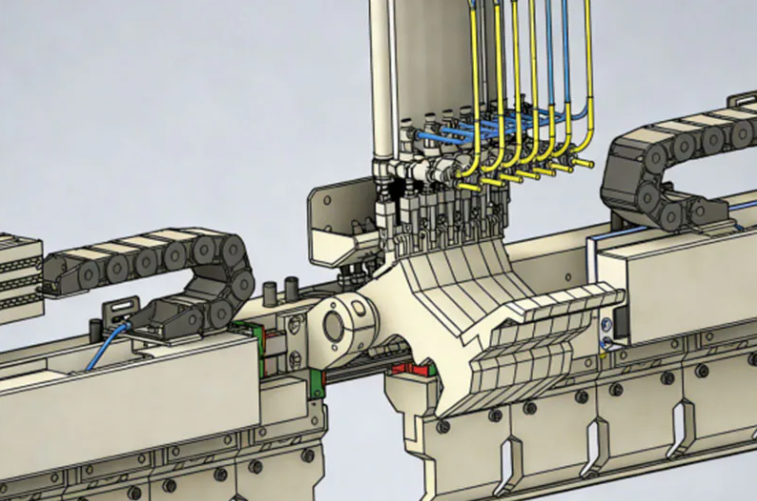
Rather than relying on single-piece tooling, the machine operates with several standardized tool segments. The CNC controller automatically determines the needed tool length and builds the correct tool stack by combining segments.
As a result, the operator no longer has to manually set up tooling for each individual part.
Modular Tooling System
The adv machine breaks conventional full-length tools into multiple common segment sizes, including 50 mm, 100 mm, 200 mm, and 300 mm.
With this approach, the system can produce many different tooling lengths using one shared tooling kit.
For more demanding bending jobs, the machine can also run hinged tooling. These tools automatically clear previously formed flanges to prevent collisions and interference.
A single tooling set can cover a broad range of part dimensions, eliminating the need to buy numerous dedicated tool sets. The improved tooling layout also minimizes wear and helps extend overall tooling service life.
Automatic Tool Combination Mechanism
This mechanism serves as the central foundation of the system.
After the CNC system identifies the required tool length, servo motors drive the positioning unit, moving each tool section into the correct place.
The machine automatically sorts, aligns, and locks the sections together to achieve the needed bending length.
Operators don’t have to take off or swap out the full tooling arrangement.
The machine finishes size adjustments in seconds. Compared with manual tool assembly, it can cut changeover time by over 70%.
Fully Electric Servo Drive
The machine relies on servo motors for both tool assembly and the bending process.
The servo system reacts quicker than hydraulics. It provides greater positioning precision and uses less power.
It also runs quieter and needs less routine maintenance.
These benefits enable manufacturers to lower operating costs while boosting overall productivity.
How Automatic Tool Combination Works
The CNC system manages the entire sequence automatically.
The operator imports a part drawing. The system extracts the bending parameters, identifies the best tooling mix, selects the required tooling sections, and completes the full tooling configuration.
The machine then begins bending right away.
Drawing Analysis
The CNC controller pulls the bend length, bend locations, and bend order straight from the drawing.
It evaluates every bend step and defines the tooling length needed.
Automatic Tooling Calculation
The system reviews several tooling arrangements and chooses the most productive option.
It factors in bend length, tool requirements, and overall throughput simultaneously.
Tool Selection
The system determines the number and type of each tooling section.
It then pulls the necessary tools directly from the tooling database.
Automatic Tool Assembly
The tool-handling unit picks each tooling section based on the computed plan.
The machine positions and mounts the tooling automatically.
No manual setup is required from the operator.
Ready for Forming
Once the machine finishes the tooling assembly sequence, it immediately begins the bending cycle.
It rapidly shifts among various bending lengths and delivers steady, repeatable bending precision across the entire production run.
Why Is the Automatic Tool Combination CNC Press Brake Perfect for Stainless Steel Cabinet Manufacturing?
As the stainless steel cabinet industry continues moving toward high-output, standardized, and automated production, traditional bending methods are increasingly unable to meet modern efficiency and throughput requirements.
The Automatic Tool Combination Press Brake solves these issues by removing repetitive tool setup work and boosting overall manufacturing productivity.
Built for Constant Bending-Length Changes
In stainless steel cabinet fabrication, materials, sheet gauges, and bending procedures typically stay consistent. The main difference from one part to another is bending length, including long-edge and short-edge bends.
The automated tool-combination system intelligently selects and builds the required tool length for each operation, eliminating repetitive manual tool changes and significantly increasing efficiency and output.
Ideal for Sandwich Panel Applications
Sandwich panels (composite sheets with honeycomb or insulated cores) are commonly used in stainless steel cabinet manufacturing.
Most bend heights remain under 30 mm.
Equipped with a specially designed gooseneck punch, the machine provides exceptional clearance, prevents collisions during forming, and ensures top-tier bending results, while delivering stable, consistent fabrication performance across most sandwich panel cabinet applications.
Increased Productivity for High-Volume Manufacturing
Cabinet manufacturing usually includes large batch orders and tight delivery timelines.
Automatic tool-changing integration minimizes downtime caused by manual tooling assembly and setup, enabling continuous running, improving throughput, and maximizing overall capacity and equipment utilization.
Reduced Labor Requirements and Operating Costs
Part files and bend settings can be saved within the CNC controller and retrieved immediately whenever required.
When measured against traditional press brakes, this setup minimizes hand calculations, tool choosing, and repeated setup tweaks. As a result, it decreases the level of operator expertise needed, cuts labor spending, and strengthens overall output uniformity.
Conclusion
For stainless steel cabinet production, sandwich panel bending remains one of the most common and most essential operations. Under normal shop conditions, the alloy type and sheet gauge typically remain the same, while the bend length is adjusted to match the honeycomb core structure and the internal arrangement.
Therefore, the Automatic Tool Combination CNC Press Brake is one of the smartest, most workable choices for modern stainless steel cabinet fabrication, enabling higher throughput, faster changeovers, lower labor costs, and greater manufacturing agility.