Đường dây nóng hỗ trợ khách hàng 24/7: +86 15395181370



If you are considering investing in a sheet metal press brake, you are facing one of the most consequential equipment decisions for your workshop. The right machine boosts throughput, cuts scrap, and opens new job opportunities. The wrong one eats into margins and ties up operators.
This guide break down everything you need to know—from basic working principles to model-specific strengths, critical selection parameters, and how to choose a builder that delivers long-term value.
What Is a Press Brake?
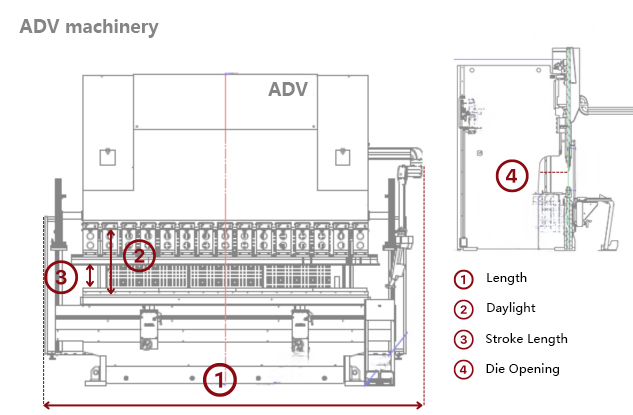
A press brake is a machine tool that bends and shapes sheet metal by applying controlled force between a punch (upper tool) and a die (lower tool). The workpiece sits on the bed; the ram (upper beam) descends with hundreds of tons of clamping pressure to form a precise bend angle.
Press brakes handle everything from simple V-bends to complex multi‑step profiles on a single panel. Their construction—frame, hydraulic or electric drives, control system, and tooling—directly determines repeatability, energy cost, and operator safety.
How Does Press Brakes Work?
Regardless of the drive technology, the basic cycle is identical:
- The operator positions the sheet between punch and die.
- A foot pedal or CNC command initiates the stroke.
- The ram moves downward, pressing the metal into the die cavity.
- The material takes the shape of the toolset.
The bend angle and depth are defined by the punch radius, die opening, and stroke depth. Modern CNC controls adjust all parameters automatically, but the mechanical precision of the frame and tooling still governs final quality.
What Goes into Building a High‑Quality Press Brakes?
A press brake is only as good as its construction. Leading manufacturers design frames with single‑piece steel shoulders—cut in the rolling direction to ensure perfect symmetry and grain alignment. Welding is performed by certified specialists, and visible welds often signal confidence in workmanship.
Post‑weld operations are equally critical. Boring and milling create perfectly flat, parallel surfaces that guarantee accurate alignment of slideways, cylinders, and tooling. In‑house machining with large‑scale boring mills (e.g., Soraluce) and multi‑axis machining centres ensures tolerances measured in hundredths of a millimetre.
Every hydraulic cylinder and circuit is bench‑tested before assembly. This step prevents leaks, ensures synchronized movement, and extends seal life. The motto: quality is non‑negotiable at every production stage.
The Three Main Press Brakes Types
Today’s market offers three dominant architectures. Each serves different production profiles.
1. Hydraulic Press Brakes
- Most common – widely installed, with many builders.
- Working principle – hydraulic oil drives the cylinders; the pump runs continuously.
- Pros – high approach and return speeds; very versatile across material thicknesses and lengths; still a solid choice for general fabrication.
- Cons – higher energy consumption (pump always on); larger oil volume needed; temperature variations affect bend consistency; requires skilled operators to dial in first‑off parts.
- Best for – job shops with mixed, medium‑volume work where ultimate speed is not the priority.
2. Hybrid Press Brakes
- Evolution – combines hydraulic power with servo‑controlled pump technology.
- Key differentiators – dual‑tank oil system reduces fluid volume by 50–70% versus pure hydraulic models. Stable oil temperature means consistent viscosity and far better bend repeatability.
- Performance – faster cycle times than hydraulic presses; excellent for diverse, short‑run jobs where setup and stability matter.
- Best for – contract metal fabricators handling many different batches with tight deadlines, where per‑part cost must remain competitive.
3. Electric (Servo‑Electric) Press Brakes
- Drive – no hydraulic oil. Force is generated by electric motors driving ball screws or belt‑and‑pulley systems.
- Benefits – lower energy use; clean operation (no oil leaks); high precision for thin to medium‑thickness sheets.
- Frame design – often an “O”‑shaped closed frame for added stiffness, because electric drives cannot easily compensate frame deflection in real time.
- Deflection compensation – on electric machines up to 2000 mm, crowning (if present) is usually wedge‑based and manually preset—not real‑time. This limits their ability to maintain absolute linearity over long workpieces.
- Best for – thin‑gauge production, electronics enclosures, and applications where oil cleanliness is critical.
Note: ADV Machinery uses a “C”‑frame design on hydraulic and hybrid models, combined with a real‑time active crowning system (FLEX) that measures deflection with sensors and adjusts cylinder pressure instantly—delivering perfect linearity without manual corrections.
Key Selection Factors – Your Pre‑Purchase Checklist
Choosing the right press brake is not about picking the biggest tonnage. It is about matching machine capabilities to your actual production profile.
🔹 Tonnage (Press Force)
The material type, thickness, and bend length determine the required force. Most models include tonnage in their name. Rule of thumb: under‑sizing causes inaccurate bends; over‑sizing wastes energy, reduces working speeds, and drives up purchase cost.
Calculate your maximum required tonnage for the thickest, strongest material you regularly process. Then add a 10–15% safety margin.
🔹 Material Thickness and Type
- Thick plates demand higher force and a stiffer frame—often moving you to a larger frame size.
- Thin, large sheets are harder to handle and position precisely; here, CNC backgauges and operator aids become critical.
- Material variety (steel, stainless, aluminium, high‑strength alloys) affects springback and requires flexible control over speed and pressure.
🔹 Batch Diversity (Lots)
- Few pieces, many different jobs – invest in quick‑change tooling systems (Promecam or Wila) or even an automatic tool changer (ATC) to slash setup downtime.
- Large, repetitive batches – prioritise cycle speed and repeatability; hybrids often shine here.
🔹 Bend Quality Requirements
Quality can mean different things:
- Dimensional precision – constant angle and straightness across the entire length (critical for automotive, industrial vehicles, hospital furniture, and modular assemblies).
- Surface finish – no tool marks, scratches, or burrs (essential for visible architecture, design furniture, art pieces, and commercial kitchens).
Your intended market will dictate whether you need real‑time crowning, advanced software, or specialised tool coatings.
How to Get Perfect Bends – The Crowning Factor
Perfect linearity over the full length is the hardest challenge in press brake engineering. Here is how different technologies address it:
| Công nghệ | Crowning method | Real‑time feedback? |
|---|---|---|
| Electric | Wedge‑based manual preset (below 2 m) – rarely used above that | No – values set from tables/experience |
| Hydraulic | Wedge or hydraulic crowning (often optional) | Some models offer automatic, but not always instant |
| Hybrid (ADV style) | Active hydraulic crowning with sensors at key deflection points | Yes – sensors measure actual beam deflection in hundredths of a millimetre and adjust cylinder pressure on the fly – fully automatic, no operator guesswork |
For guaranteed straightness without trial‑and‑error, a hybrid press with active crowning is the modern standard.
Choosing Press Brakes Manufacturer – More Than a Price Tag
Selecting a builder is as strategic as selecting the machine itself. Consider these criteria:
- Track record – How long have they designed and built presses? Do they specialise in metal forming or just assemble bought‑in components?
- Range and customisation – Do they offer models that fit your tonnage, length, and automation needs—or do they push a one‑size‑fits‑all solution?
- Engineering depth – Do they perform in‑house boring, welding, and testing? This usually signals superior quality control.
- Support network – Is technical assistance local? Are spare parts readily available? Is operator training included?
- Innovation – Do they invest in R&D (e.g., real‑time crowning, ATC, IoT connectivity)?
- Proximity – A nearby manufacturer often means faster response times and easier factory visits.
Price matters, but it is not the final word. A cheaper press brakes machine with poor support will cost more in downtime and rework within two years.
Small Batches vs. Large Batches – What Changes?
- For small, varied batches – rapid tool change is king. Look for quick‑clamp systems or an automatic tool magazine (ATC) that serves tools without operator delay. Minimising idle time between setups directly reduces your hourly job cost.
- For large, repeated batches – speed and consistency matter most. Hybrid drives with stable oil temperature and active crowning deliver uniform parts with fewer rejected pieces.
Also consider the design of new components: if you can standardise tooling across multiple families, you reduce changeovers even further—boosting competitiveness.
Real‑World Cases – Quality Opens New Markets
Consistent bend quality does more than satisfy prints. One ADV customer bought a hybrid press primarily for light structural work. The machine’s accuracy and surface finish allowed them to pivot into artistic metalwork—creating sculptural animals and high‑end designer furniture—transforming their business and margins.
Similarly, automotive suppliers use hybrid presses with active crowning to produce heavy chassis components that must mate flawlessly with other stamped parts, eliminating secondary straightening operations.
Final Takeaway – Your Press Brakes Decision Roadmap
- Define your materials – thickness range, types, and lengths.
- Estimate your tonnage – be realistic; avoid over‑ or under‑buying.
- Analyse your production mix – batch sizes and diversity dictate automation level.
- Prioritise bend quality – decide whether you need real‑time crowning or can work with manual presets.
- Evaluate manufacturers – look for in‑house engineering, proven reliability, and responsive after‑sales.
- Consider total cost of ownership – energy, oil consumption, maintenance, and scrap rate matter more than purchase price.